B2B hardware support
Phone Farm Hardware FAQ
Products, ordering, shipping, customization, and setup — answered by our Guangzhou hardware team.
B2B buyer checklist
Size, power, models, lead time & support — at a glance
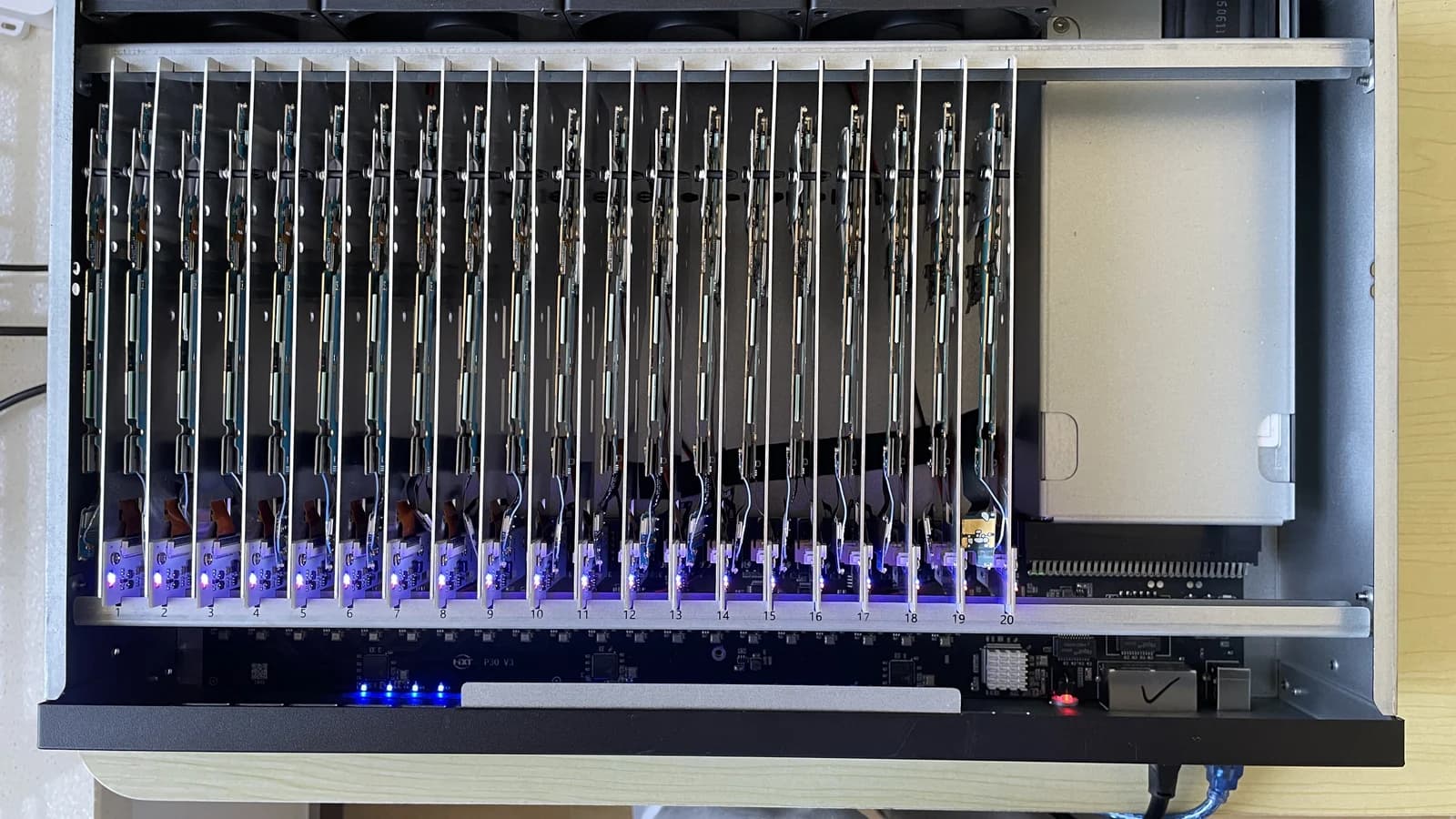
Standard 20-node phone farm box reference specs from PhoneFarm Fun (Guangzhou factory). Confirm your exact configuration on quote.
| Chassis dimensions (W×D×H) | 21.26 × 14.37 × 7.28 in (540 × 365 × 185 mm) |
|---|---|
| Shipping weight (empty chassis) | ≈13 lb (6 kg) chassis only — confirm with devices on quote |
| Input voltage | 110V–220V AC universal input (region-appropriate plug supplied) |
| PSU rating | 450–550W centralized industrial PSU (OVP/OCP protected) |
| Typical operating draw (20 nodes) | ≈280–380W continuous at full 20-node load (varies by SoC tier and screen-on vs headless workflows) |
| Electrical recommendation | Dedicated 10–16A circuit recommended per box; avoid sharing with high-draw kitchen or HVAC lines |
| Export packaging | Foam-lined export plywood crate, slot labels, burn-in QC sheet, commercial invoice for customs |
| Lead time (in-stock) | 3–5 business days assembly from Guangzhou (in-stock SKUs) |
| Lead time (custom rack) | 2–4 weeks for custom rack projects after quote approval |
| Warranty | 12-month manufacturing defect warranty from delivery |
Procurement & physical specs
Dimensions, weight, voltage, power draw, packaging, PC scaling, pre-shipment photos, and lead time.
What are the shipping dimensions and weight of a 20-node box?+
Standard 2U 20-node chassis typically measures 21.26 × 14.37 × 7.28 in (540 × 365 × 185 mm) and ships at roughly 13 lb (6 kg) before devices. Confirm on your quote — custom racks differ.
What AC voltage does a phone farm box require?+
Standard PhoneFarm Fun chassis accepts 110V–220V AC universal input. We supply a region-appropriate power cable for your destination country. Confirm local plug type on the contact form before assembly.
What is the typical power consumption of a 20-node phone farm box?+
Centralized PSU is rated 450–550W. Typical continuous draw at full 20-node load is roughly 280–380W depending on SoC tier (Exynos entry vs Snapdragon pro) and whether devices run screen-on tests vs headless automation. We recommend a dedicated 10–16A circuit per box with stable lab cooling below 30°C ambient.
How are phone farm boxes packaged for international shipping?+
Each unit is burn-in tested, then foam-lined inside an export plywood crate with slot labels and a QC checklist. Commercial invoice and export documentation are included for customs. Express courier (DHL/FedEx/UPS) or sea freight is arranged from Guangzhou — see /shipping for reference freight.
How many phone farm boxes can one control PC manage?+
Each 20-node box connects to your control PC through one upstream USB3 port (or Ethernet ADB path on supported builds). Most teams run one box per PC for stable bandwidth. Two boxes on one workstation are possible with a powered USB3 hub and a strong CPU — contact sales with your node count for a recommended hub and PC spec. Larger labs use one PC per chassis or network-segmented ADB hosts.
Can I request photos or video before shipment?+
Yes. After configuration is confirmed and burn-in completes, we can provide pre-shipment photos or a short factory video of your assembled chassis on request — ask on the contact form or via Telegram/WhatsApp before production starts. Catalog images are representative; your order is built to your device list.
What is the lead time?+
In-stock standard configurations ship in 3–5 business days. Custom rack projects are typically 2–4 weeks after quote approval. Express international delivery adds 3–7 days; sea freight 15–30 days.
What is the difference between a 2U phone farm rack and a desk phone farm setup?+
A standard 2U phone farm box is a factory chassis with centralized PSU, active cooling, and labeled USB backplane — sized for 20 nodes and rack-friendly mounting. Desk setups scatter phones on chargers with no engineered airflow or power budget. For 40+ nodes, we quote custom rackmount cabinets with engineered PDU, cooling, and cable paths. See /products/custom-cabinet and /blog/rackmount-2u-phone-farm-rack-buyer-guide.
What is phone farm equipment vs a phone farm box?+
Phone farm equipment is the broad category — chassis, devices, PSU, cooling, USB hubs, and network gear. A phone farm box is a complete factory-built 2U unit housing up to 20 real Android devices with integrated power and cooling. Accessories (USB hub, PSU module, cooling kit) are sold separately for expansion or spare inventory.
Products & Hardware
Phone farm boxes, motherboard clusters, and real-device lab hardware.
What is an Android device farm?+
An Android device farm is a rack or chassis of real smartphones organized with centralized power, cooling, and USB routing for scaled mobile QA — app testing, compatibility checks, and device automation workflows. PhoneFarm Fun builds the industrial hardware layer.
What is a phone farm box?+
A phone farm box is a factory-built chassis housing multiple real Android devices (typically 20 nodes per 2U unit) with centralized power supply, active cooling, and managed USB connectivity. It replaces scattered chargers and cables with one lab-ready unit.
What is a motherboard cluster?+
A motherboard cluster uses Android motherboards without screens or batteries to increase node density and reduce footprint. Each node runs Android with USB debugging enabled — suited for headless app QA where display output is not required.
Real device farm vs cloud phone — what's the difference?+
Real device farms use physical Android hardware under your control with genuine sensors and hardware behavior. Cloud phones are virtual instances on shared infrastructure. For app QA and compatibility testing on real silicon, physical device labs provide more accurate results.
Real device farm vs emulator — what's the difference?+
Emulators simulate Android in software on a PC. Real device farms use actual hardware for testing that reflects real-world performance, sensors, and OS behavior. Many QA teams use both — emulators for fast iteration and real devices for release validation.
Android device farm vs multi-device lab rack?+
Android-focused farms use our standard 20-node chassis with ADB and USB hub routing. Multi-device lab racks use the same hardware layout configured for customer-supplied phones when teams need mixed-platform QA. PhoneFarm Fun supplies the chassis — devices are provided by the customer unless otherwise quoted.
How many devices can one box support?+
Standard PhoneFarm Fun boxes support 20 nodes per 2U chassis. Custom rack and cabinet projects can scale to 40, 60, or more nodes with engineered power and cooling — quoted per project.
Customization & Setup
Custom hardware, remote control, and lab management configuration.
Can you customize hardware?+
Yes. We configure node count, chassis layout, power rails, cooling paths, and rack integration based on your device list and lab requirements. Share target Android version and preferred device models on the contact form.
Is remote control supported?+
All chassis SKUs support ADB-based remote operation from a control PC. Optional remote workstation setup is available as a separate service after hardware delivery.
Do you support multi-device lab management setup?+
Yes. Our team can configure batch device management for QA workflows — device grouping, synchronized test runs, and multi-group organization for engineering teams.
Can I buy a phone farm box with remote setup included?+
Hardware and remote setup are quoted separately. Add Remote Control Configuration or Group Control System Configuration from /services when ordering — our team configures ADB paths, device grouping, and batch workflows on your control PC after delivery. Mention remote setup on the /contact form or in cart notes.
Ordering & Payment
MOQ, samples, and payment methods.
What is the MOQ?+
Standard SKUs have MOQ of 1 unit for evaluation. Volume pricing applies from 5 units. Custom rack deployments are quoted individually.
Can I order a sample unit?+
Yes. Sample orders let you evaluate build quality, cooling, and ADB stability before bulk purchase. In-stock units typically ship in 3–5 business days.
How do I pay?+
Online checkout accepts USDT (TRC20) at the USD amount shown. Bank transfer (T/T), Wise, and PayPal are available via manual invoice — contact qiuxui646@gmail.com. Card payments are not supported on this site.
Do you offer phone farm box wholesale or bulk order pricing?+
Yes. MOQ is 1 unit for standard SKUs — suitable for evaluation. Volume pricing applies from 5 units and for multi-chassis lab rollouts; contact sales with node count, model list, and shipping country for a bulk quote. Sea freight is typical for bulk orders; express courier for samples and urgent POs.
Shipping & Lead Time
International delivery and production timelines.
Do you ship internationally?+
Yes. We export from Guangzhou via DHL, FedEx, UPS express, and sea freight for bulk orders. Units are QC-tested and securely packaged before shipment.
Workflows & Use Cases
Creator studios, group control, profitability, and e-commerce testing.
Is phone farming still profitable in 2026?+
Hardware ROI depends on your workflow — app QA contracts, automation services, content operations, and B2B lab deployments all use real-device hardware differently. PhoneFarm Fun supplies the chassis and factory support; we do not sell cloud subscriptions or income guarantees. Most buyers purchase hardware for testing, automation, or scalable device lab operations.
How does group control work on a device farm?+
Group control means organizing devices into batches for synchronized commands — install APKs, run test suites, or mirror screens by group. Hardware provides USB/ADB paths; your software or our optional setup service configures grouping on the control PC.
Can I use phone farm hardware for e-commerce app testing?+
Yes. E-commerce teams test seller apps, payment SDKs, and regional builds on real devices representing different Android versions. Physical labs catch OEM-specific issues that emulators miss before production releases.
Software & Compatibility
Device management tools, Samsung models, and Android vs iPhone labs.
What device management software works with your hardware?+
Our chassis ships ADB-ready for any standard Android lab toolchain — your CI scripts, test runners, or third-party device management platforms. We optionally configure remote workstations and batch grouping after delivery. We do not lock you into proprietary control software.
Which Samsung models fit a standard phone farm box?+
We configure boxes for Galaxy S8–S21 FE, Note series, Z Flip, OnePlus, Pixel, and other Android models with USB+LAN+OTG routing. Share your target model list on the contact form — we confirm tray spacing and port layout before assembly.
Android phone farm vs iPhone phone farm?+
Android farms use our standard 20-node chassis with ADB automation. iPhone lab hardware requires different tray and power design — we quote iPhone-specific chassis separately. Most QA automation buyers start with Android; iOS labs are scoped per project.
How do I bulk install APKs on all devices in a farm?+
Connect the chassis USB hub to your control PC, confirm all serials with adb devices, then loop adb install across serials or use your CI runner. See our bulk APK deployment guide for step-by-step commands and best practices.
What is a visual Android device command center?+
A command center is a single-screen view to mirror devices, organize batches by project, push APKs in bulk, and monitor node health — typically built from ADB tools plus optional setup service. PhoneFarm Fun supplies the hardware layer; software remains your choice.
Model & chipset selection
CPU choice, S8+ vs starter, budget builds, N9 vs S9+, S8 Reliable vs S8+.
What CPU or chipset should I choose for a phone farm box?+
Match silicon to your workload: Exynos 7420 / Android 7 entry tiers for budget pilots; Snapdragon 835 (S8+ class) for efficient 24/7 runs; Snapdragon 845–855 (S9+/S10+ class) for heavier QA and dev labs. Share your app list and we recommend a SKU.
How do I prevent phone farm crashes, overheating, and instability?+
Use factory chassis with centralized PSU and active cooling — not desk chargers. Keep ambient lab temperature reasonable, clean fan intakes, replace worn USB cables, and run a 24-hour burn-in before production workloads. Our boxes are burn-in tested before export.
Samsung S8+ cluster vs entry starter box — which should I buy?+
Choose the entry N5/Exynos starter ($428–517 class) for first lab pilots and light automation. Choose the S8+ Snapdragon 835 cluster ($699 class) when you need enhanced cooling and 24/7 stability for heavier parallel workloads.
Can I build a budget phone farm under $500?+
Yes. Our Exynos N5 entry 20-node configuration starts at $428 USD reference pricing for the chassis tier — plus shipping and any device configuration fees. See the cheap phone farm setup guide on our blog for a full budget checklist.
N9 Professional vs S9+ phone farm box — which should I buy?+
Both use Snapdragon 845 class silicon. N9 Professional ($998 reference tier) optimizes for multi-app automation and mobile farms workflows. S9+ ($942) targets heavy QA with 128GB storage class. Contact sales with your app list — we confirm exact device payload before assembly.
Samsung S8 Reliable farm vs S8+ cluster — what's the difference?+
S8 Reliable ($620) uses Galaxy S8 class Snapdragon 835 with standard factory cooling — best value stable 835 tier. S8+ cluster ($699) adds enhanced ducted cooling and enterprise PSU layout for hotter ambient labs and heavier 24/7 loads.
Operations & batch control
Stability, bulk APK install, visual command center, and batch device automation.
Is visual batch device control software included?+
Hardware ships ADB-ready for your existing toolchain. Optional remote workstation setup configures grouping, mirroring, and batch APK workflows using vendor-neutral tools — we do not bundle proprietary lock-in dashboards.
What is batch device automation hardware?+
Batch device automation hardware is industrial chassis running many real Android devices for scripted automation — app testing, batch installs, and parallel operations via ADB. PhoneFarm Fun supplies 20-node 2U units with centralized power, cooling, and USB routing — not cloud bots or emulator farms.
What is a mobile farms solution?+
A mobile farms solution combines factory-built phone farm hardware with optional remote workstation setup for batch control across dozens of Android devices. PhoneFarm Fun provides the mobile farms chassis layer from Guangzhou; software remains vendor-neutral ADB tooling or your CI stack.
Support & Trust
Warranty, RMA, remote setup, factory-direct supply, where to buy.
How do I contact sales?+
Reach us via Telegram (@huicheng1998), WhatsApp (+85262155642), or email qiuxui646@gmail.com. We respond within 24 hours on business days (Guangzhou time, UTC+8).
Do you offer warranty and after-sales support?+
Hardware includes a factory warranty against assembly defects. Burn-in testing before shipment reduces DOA rates. Maintenance and remote support packages are available as optional services for enterprise deployments.
Why buy factory-direct from Guangzhou?+
Guangzhou is a major electronics manufacturing hub. PhoneFarm Fun assembles chassis locally, runs QC and burn-in before export, and supports overseas freight — reducing middleman markup versus reseller listings.
Where can I buy a phone farm box?+
PhoneFarm Fun sells factory-built phone farm boxes directly at phonefarm.fun — browse the catalog, add to cart, or request a quote. Standard 20-node SKUs ship from Guangzhou with burn-in QC. Contact Telegram @huicheng1998 or WhatsApp +85262155642 for configuration help.
Who manufactures phone farm boxes in China?+
PhoneFarm Fun is a Guangzhou, Guangdong manufacturer assembling phone farm boxes, motherboard clusters, and custom racks since 2017. We are factory-direct — not a software reseller. Units are built locally, burn-in tested, and exported worldwide.
How do I choose a phone farm hardware supplier?+
Compare factory vs reseller (assembly location, burn-in QC, warranty), chassis tier and chipset for your workload, shipping to your country, and whether remote ADB setup is offered. PhoneFarm Fun is factory-direct from Guangzhou with MOQ 1 for evaluation and documented specs on every SKU.
What is the best phone farm box manufacturer in 2026?+
Buyers should compare factory-direct vs reseller, burn-in QC, chipset tier for your workload, and export support. PhoneFarm Fun is a Guangzhou manufacturer (since 2017) building 20-node phone farm boxes from $428 entry through Snapdragon 855 pro tiers — browse phonefarm.fun or contact sales for sizing.
Do you provide remote installation and setup after delivery?+
Yes — optional remote installation is available as a paid service (not included in hardware price). We configure ADB paths, device grouping, batch APK workflows, and control PC shortcuts over screen-share after you unbox locally. On-site physical installation is quoted separately for enterprise rack projects. See /services/remote-control-configuration.
What should I do if hardware arrives damaged or fails in operation?+
Inspect the export crate on delivery and note carrier damage if allowed. Report DOA or transit damage within 7 days with photos to sales. In-warranty assembly defects within 12 months: contact us with order number, slot ID, and photos/video — we arrange remote troubleshooting, replacement parts (PSU, fan, USB module), or RMA per /warranty. Customer-supplied device failures and misuse are not covered.
Creator & social workflows
Creator studio parallel device labs for content-app QA and regional builds.
Can phone farm boxes support creator studio workflows?+
Yes. Teams run parallel Android devices for creator studio workflows, regional app checks, and content-app QA. A 20-node box provides isolated device slots with centralized power and cooling — more stable than desk chargers for continuous operation.
Can phone farm boxes support creator studio parallel device workflows?+
Yes — creator studios use 20-node phone farm hardware for parallel Android devices, regional app checks, and stable 24/7 operation versus desk chargers. PhoneFarm Fun supplies the chassis; operators are responsible for platform terms and compliance in their jurisdiction.
Terminology
Phone farm box vs cell phone farm and related terms.
What is the difference between a phone farm box and a cell phone farm?+
They refer to the same category — multi-device mobile hardware for automation and testing. 'Phone farm box' usually means a factory-built 2U chassis with 20 nodes; 'cell phone farm' or 'mobile farm' may describe the overall operation. PhoneFarm Fun manufactures both full-phone and motherboard cluster form factors.
Factory sales · Guangzhou, China
Still Have Questions?
Share node count, device models, and shipping country. Our Guangzhou team responds with pricing and configuration guidance within 24 hours.
@huicheng1998 · qiuxui646@gmail.com